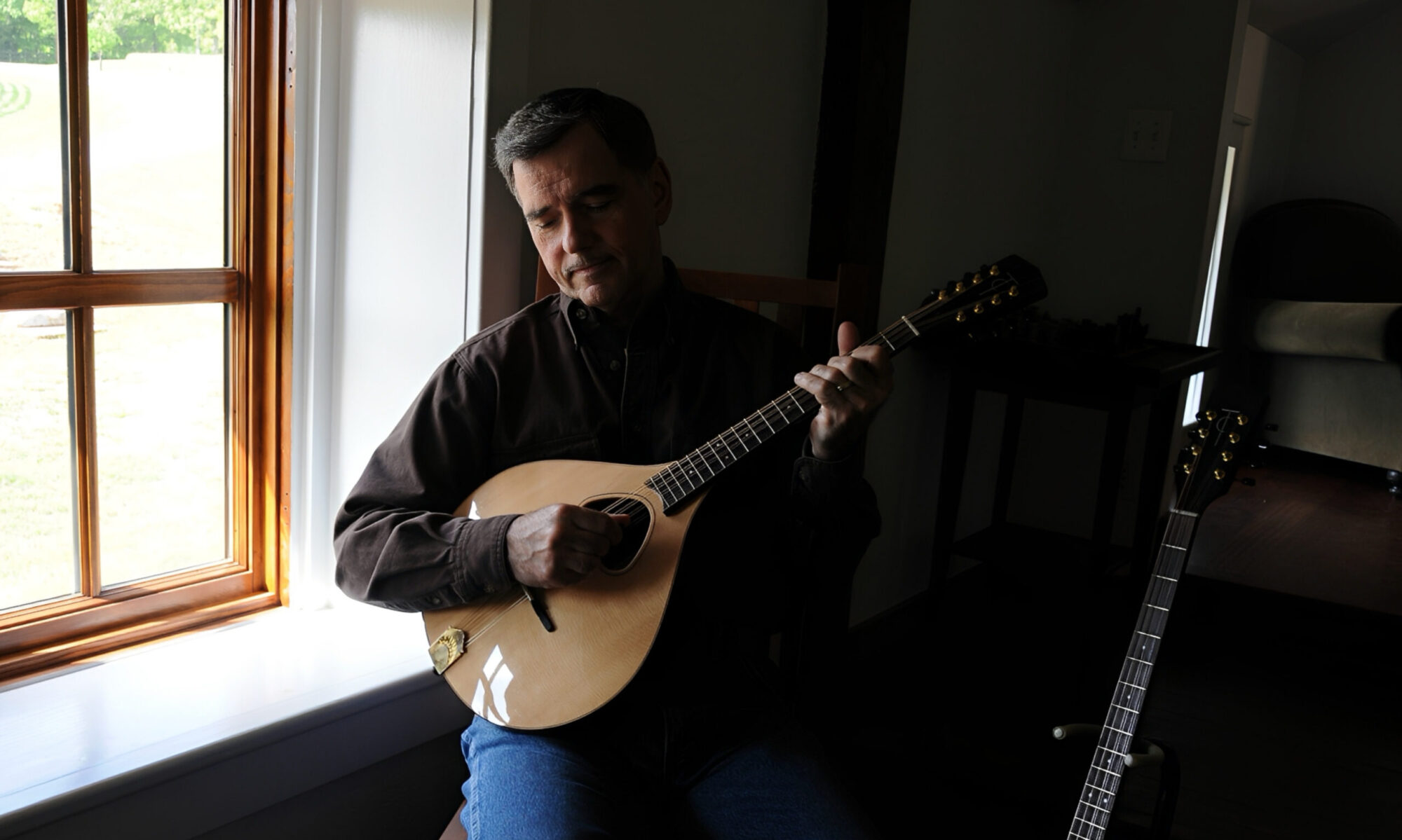

Welcome to the mandolins page. This is a year by year list of the mandolins and related instruments Jimmy used throughout his career along with their stories, written by Jimmy. The images of the instruments are the actual instruments Jimmy used except the Rex, Gibson F-4, and the octave mandolin and bouzouki. Those images are true or close examples of the ones Jimmy used.
1964 – Early 1900s Rex
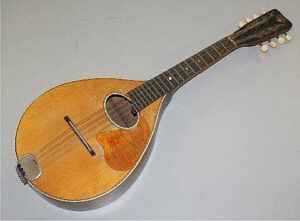
You can find these on the internet in both bowl-back and flat-back versions. Mine was a basic flat-back which I got from Bill Rawlings before we put together our first band.
1965 – Early 1900s Gibson F-2
A black top version I purchased from the music store owned by Fred Pike and Sam Tidwell in Plainfield, CT. It was a giant step up from the Rex, which was a decent “learner” that I kept for a number of years and eventually used on a couple of cuts on The Gaudreau Mandolin Album (1978). To hear it played, listen to “Jesu, Joy of Man’s Desire” on the video page. The F-2 can be heard on the Fred Pike, Bill Rawlings, and the Twin River Boys album (1965) and seen on its cover.
1966 – Early 1900s Gibson F-4
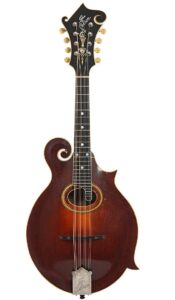
A sunburst red model which again, I had gotten word had just arrived at Fred & Sam’s music store. A superior instrument to my F-2 and a trade up deal I couldn’t resist. During the short time I had it, I didn’t have a chance to take photos or record with it.
1967 – 1925 Gibson F-5
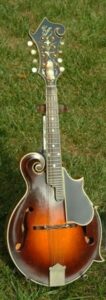
After completing basic training at Fort Dix, NJ, I caught a flight to Bradley International, where I was picked up by my good friend Ron Siff, who had offered to take me to a gig with the Twin River Boys in Boston. I had assumed that Bill Rawlings would be bringing my mandolin and I was both surprised and confused when Ron said he had my mandolin sitting behind me on the back seat. I was even more confused when I turned around and saw it was not my form-fit case but one that was oblong shaped. To say I was surprised doesn’t come close to what I felt when I flipped the latches and opened it up. It literally brought me to tears and I was completely speechless. There before my eyes was one of the most coveted mandolins in bluegrass – a vintage Fern!
I later learned that when the person that had purchased it from the original owner decided to part with it, Sam Tidwell was among the first to be notified, which put the wheels in motion. Ron, who helped manage B&W Footwear, a family-owned business in Webster, MA, was among other things a huge fan of bluegrass. His hiring of the Twin River Boys for a company party in 1965 led to him forming Osage Records and our first and only studio recording. He went on to sponsor the band’s weekly radio show on WINY, Putnam, CT, produce headliner level concerts at the prestigious Mechanic’s Hall in Worcester, MA, and ultimately became the driving force in the decision to make sure the mandolin ended up in my hands. A deal was struck which involved my giving him my F-4 and thus the Fern became my primary stage and recording mandolin for the next 18 years. After rejoining the Country Gentlemen in 1981 I used it on Good As Gold, the only recording I made with them during my 4-year stint, which would be the last time I used it in the studio.
1975 – Early Gibson A model
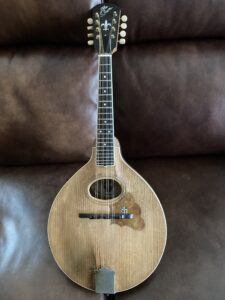
In the summer of 1975 several events occurred that would impact bluegrass music, some more lasting than others. J.D.Crowe & the New South would release what was soon considered a landmark album – Rounder 0044, as it is commonly referred to in bluegrass history. If you care to research that you’ll also learn that three of the major players on that recording left the band at around the same time of that release. J.D. was faced with rebuilding the group and after his first attempt didn’t work out well, a phone call would prompt me to fly to Lexington, KY, to discuss the possibility of my joining the group.
After picking me up at the airport he drove us to his home and while pulling his cool 240-Z into the garage, a cardboard box on an upper shelf with a mandolin headstock sticking up caught my attention. I would soon learn that it once belonged to Larry Rice when he a member of the Kentucky Mountain Boys which in 1971 changed its name to The New South after Larry’s brother Tony joined the group. At some time before Ricky Skaggs and Jerry Douglas joined the group in 1975 for what would be a brief stay, Larry left J.D. evidently owing him $50 and J.D. agreed to accept the mandolin in lieu of the $50. I never found out how Larry had acquired it or if the neck was already detached but for the sum of $50 I ended up with the mandolin. Did I need it? No. So, I kept it in the same box on a closet shelf until I figured out what to do with it. The answer came in 1979 after I left J.D. to help form Spectrum with New South alumnus Glenn Lawson, plus Mark Schatz and a young Bela Fleck, both having left Massachusetts based Tasty Licks and relocating to Lexington.
It was during this time that I had the occasion to return to my home state of Rhode Island and while there was invited to tour Guild Guitars, where my sister worked in the office of their Westerly-based division. During the tour, she introduced me to their chief repairman whom I was told was an avid bluegrass fan and very familiar with my name and involvement. The conversation quickly went to my vintage F-5 and then came around to him asking if I had any other mandolins. That opened the door to something I didn’t see coming but once it did, I gave him the short version of my $50 acquisition. Then one thing led to another and voila! A plan came together.
On his own time, he would put it back into playing condition, leaving it unfinished, but rather than use the original neck, he’d build one from wood that he’d rescued from their dumpster. The new neck would have a longer scale, joining the body at the 15th fret rather than at the 12th. It would involve moving the location of the bridge forward and thus additional bracing, but he was up for the challenge and I loved the idea. His more-than-reasonable estimate for the work resulted in our shaking hands and my arranging to get my box of body parts plus old tailpiece and vintage tuning keys to him through my sister, who would act as a liaison throughout the process and would notify me if and when he succeeded. Knowing that he was working on his own time, I waited patiently and when I finally got the call from my sister, I was both happy and relieved to hear that the operation was indeed successful.
Since I had originally sent it in a box without a case, I was reluctant to have it returned to me in the same manner. Mark and Bela came to the rescue. They already planned to drive back to Massachusetts for a visit and to pick up some things they had left behind. The timing was perfect, Westerly, RI, wasn’t far from I-95 and they were fine with picking it up. Of course, that meant that they both got to play it before me but, hey, I was getting it back.
Over the next four decades it would rarely see the inside of a case but would become my “mandolin on a stand” and a fixture in whatever family room/den came with the present and future dwellings – always within easy reach. I can safely say that the majority of the tunes I composed were done so on that instrument. Although I never planned to record with it, I did decide to use it on two CDs I recorded with Bill Clifton, Pick of the Crop (2003) and Where the Rainbow Finds It’s End (2004), as a tribute to the late Red Rector, who worked with Bill for many years playing the 1921 Gibson A-4 he’d used throughout his esteemed career.
Around 2020, I began to feel a change in the action on the treble strings and discovered a slight sag between that end of the bridge and the sound hole, which had also revealed a tiny crack on its edge. Upon this discovery, I de-tuned it and it went from a floor stand to a new home on the wall along side of my acoustic guitar and octave mandolin, which were getting used less frequently than during my performing years.
Then, in 2024, in an effort to see it enjoy yet another new life, I gave it to a younger friend/mandolin player who had the means to have it expertly repaired and shared my vision to one day pass it down to a next generation player, along with certain provisions in a more detailed version of this story. My wish is that it never be sold and bring pleasure to future players or “keepers”, as I like to call us.
1983 – The O’Brien
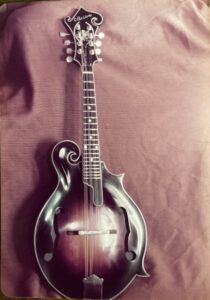
I can’t recall the location, but the Country Gentlemen were booked at a bluegrass festival somewhere in the northeast, and between sets I was approached by a fan who introduced himself as Jack O’Brien, mandolin builder. I’ve always enjoyed talking about mandolins and it didn’t take long for the conversation to come around to his having followed my career for years and the vintage Gibson I’d played throughout that time. Like a lot of builders, he’d only seen, heard, and maybe held/played but never owned one, and his goal was not to replicate but to create a mandolin that was a great sounding, quality built, and affordable alternative to the legendary Gibsons from the 1920s. I’ve had similar conversations with other builders, so this was no surprise. What did come as a surprise was when he said he would be willing to build me a custom mandolin which would incorporate every feature I could think of in order to make it unique to me – at no cost, simply on a limited endorsement basis which would end if I should choose to part with it at any time in the future. I told him I would give it some serious thought, which until then had never crossed my mind and why should I even consider it? Well, here’s why:
A) carrying a vintage Gibson on the road comes with a number of risks beyond theft and damage, which brings us to
B) insurance. Your typical homeowner’s or renter’s insurance can include a rider at additional cost, but that doesn’t cover it if you use it outside of your dwelling in a professional capacity. That requires a separate (pricey) policy, and
C) I didn’t want to modify it with the radiused fingerboard and heavier fret wire I’d seen on newer mandolins … and really liked.
To me, a vintage Gibson in near original condition should remain as such. It made more sense to replace it with an instrument that could be replaced if necessary. I gave Jack a call and the go-ahead to proceed. To view pictures taken during the final stages of completion and my first “test drive”, go to the gallery page.
NOTE: With Ron Siff’s blessing, I was able to place the Gibson in the hands of a close friend and player who shares my appreciation for the magnificent instrument that it is. Amen.
1992 – 1977 Paganoni B-model
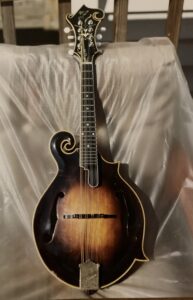
After nine very satisfying years of playing the O’Brien and no desire to replace it, I got a call from a friend who had gotten word that Les Thompson, a founding member of the Nitty Gritty Dirt Band and living in nearby Leesburg, VA, was selling the mandolin John Paganoni had made for him in 1977. I’ve known John since 1969, around the time he started building mandolins, and over the years “the Paganoni” has become one of the premier names in hand-crafted F-styles. With that in mind I called Les and arranged to meet the following day. Number 23 more than lived up to the reputation of the name. Again, I wasn’t in the market but there was no way I was going to pass up the chance to buy this magnificent instrument. In the tradition of the classic Gibson mandolins, John’s featured a flat fingerboard, which I didn’t want to go back to after playing the O’Brien for nine years. So when I called John to tell him I bought Les’s mandolin, he was delighted to hear it and proceeded to read the notes he’d taken on the #23 and kept in the file, documenting every mandolin he’d ever built. I found this to be both interesting and informative, reaffirming his meticulous attention to detail. Fearing the response, I tried my best to approach my desire to change the fingerboard to the radiused fingerboard I had gotten used to. As expected, he wasn’t in favor of that idea but in the end we decided that if it were to be done, he would be the one to do it. It was a challenge for him as he understood the concept of a compound radiused fingerboard but had never had the desire or reason to attempt crafting one, along with the accompanying bridge saddle of course. On a positive note, the successful result would mean that it would still be a 100% Paganoni mandolin. For John, anything less than success was not an option. For me, what was already an incredible mandolin got even better!
1995 – Rigel G-110
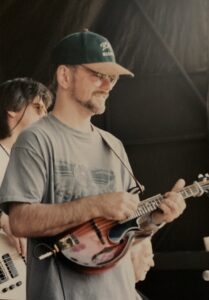
I’d been playing the Paganoni while playing dates with the Tony Rice Unit and Chesapeake. Chesapeake was a part time venture with Mike Auldridge, T. Michael Coleman, and Moondi Klein, who were all in the Seldom Scene at the time, and me. The Tony Rice Unit was an acoustic band. Chesapeake was an acoustic/electric band with T. Michael Coleman on electric bass and Mike Auldridge on (electric) steel guitar as well as resophonic guitar. 1994 found me doing less dates with the Tony Rice Unit and more dates with Chesapeake. In an attempt to create a “big sound”, Moondi had decided to put a pickup on his guitar. Mike switched to one of his resophonic endorsements that already contained a pickup. That left me fighting the urge to add anything internally or externally that would compromise the sound of my beloved Paganoni. Then, while attending the Gettysburg Bluegrass Festival, I ran into my good friend and fellow mandolin player Dave McLaughlin, who showed me a Rigel mandolin made by Pete Langdell. Pete was building Rigels in his garage shop in Jeffersonville, VT. I was immediately taken by its looks – they took me back to my days with Jimmy G & the Jaguars when my primary instrument was a Fender Stratocaster. It wasn’t particularly loud but the tone was much better than I expected from what I was told was meant to be an acoustic instrument. But in my head I was already envisioning playing one of these on stage with Chesapeake … plugged in! Dave gave me Pete’s phone number and when I called him and identified myself, he said “yeah, right”. It took me several seconds to convince him I wasn’t one of his friends or bandmates pulling his leg. Of course, I was flattered but when his first question was “Jimmy Gaudreau, why are you calling me?” I responded with the above story and then finally got around to the answer to his question. I told him I was both impressed and intrigued with his design and would seriously consider using it as my primary performance mandolin if he could install some type of internal pickup that would deliver a sound as close as possible to its acoustic quality. And, no I was not looking for a “freebie” endorsement deal and would gladly pay the price if it met my needs. He told me he was doing mostly repairs to pay the bills and really didn’t have aspirations of being able to infiltrate the bluegrass mandolin market but the more we talked the more he realized that this could be a game changer for him. He’d actually been doing some experimenting with various types of pickups and piezos and claimed that a couple were showing promise. Because of my interest, he would make a concerted effort to find the one that would meet my hopes and needs.
As it turned out, Chesapeake had a concert scheduled in the not-too-distant future in Worcester, MA. I told him that I would put him and his wife on the guest list if he’d like to attend. He thought it was unlikely that he could have a mandolin ready by then but it would give us the opportunity to meet and discuss other ideas he’d been working on since the early example I saw and played in Gettysburg. He took me up on my proposal and was able to get a room at the same hotel where the band was staying so we arranged to meet after he and his wife were settled in. Since we’d never met in person, we spent a good portion of the limited time I had before going to sound check getting acquainted. To my surprise, he said he’d brought a mandolin with him and he explained that it was his personal instrument but it would offer me the opportunity to get a second, longer look and make whatever suggestions I thought would improve it to my liking. So, I took it back to my room, then on a whim, took it to sound check where I showed it to my bandmates and sound engineer, Ed Solomon, who suggested strapping it on and seeing what it sounded like acoustically through the mic I used on my Paganoni. Sure, why not? After a couple of dial adjustments, he yelled to me from the control board in the middle of the auditorium “Man that thing sounds great!” Later, when Pete and his wife showed up for the concert, it was his turn to be surprised. I came out on stage sporting his Rigel and played it for the entire performance. To say the least, he was completely blown away. Later, back at the hotel, after recapping the concert, we decided to not rush, be patient, and get it right!
Armed with my ideas about the neck profile and string spacing, he headed back to Jeffersonville and the start of a journey that would have an effect on both of our futures. First up, what had started as dabbling with various types of transducers, piezos, etc. turned into extensive experimentation above and beyond his repair work that could not be put on hold. During this time we kept in contact, with him giving me progress updates and me responding like a coach giving a pep talk. Finally the call came with him proclaiming that after trying a number of wafer-type piezos used in various commercial applications (as opposed to musical), he’d found one that stood out and delivered excellent results. He didn’t have to give me a sales pitch, I was super excited, optimistic … sold. Since he’d been using a thin layer of a putty-like substance to stick it onto the top externally, in different locations, it quickly became evident that each area produced a different tone. We decided he would send his mandolin and the piezo for me to repeat that process to determine what I thought to be the “sweet spot”. After taking delivery it was just a matter of bringing it to the next gig and working with Ed before sound check directing me to try different locations eventually narrowing the area and ultimately moving it in tiny increments, doing a comparisons, etc. until his finely tuned ears told him I’d found the spot.
Meanwhile, back in Jeffersonville, VT, Pete was in the process of building my new Rigel complete with modified tailpiece to accommodate the end pin jack which would be wired to the piezo mounted on the underside of the top. No guesswork required as I left the piezo positioned on the top when I sent it back. Voila! A new era for Rigel Mandolins and a new chapter in my career. But wait, there’s more!
1997 – Cylinder-back mandola by Pete Langdell
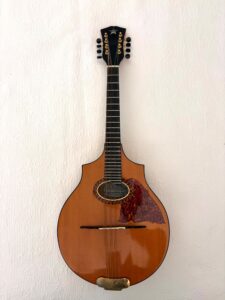
By this time, Chesapeake had become a full-time entity playing large venues and music festivals of the more progressive rather than the traditional type, one of which was Merlefest. Since we had a limited guest list and I handled the group’s CD and t-shirt sales, I invited Pete Langdell to share a portion of my merchandise table with him and however many Rigels he cared to bring and offer for sale. Along with the various models of mandolins, he brought a cylinder-back mandola crafted in the style of the Vega manufactured between 1913 and 1925, custom made for someone who wanted to play it in a mandolin orchestra, but later for reasons unknown, decided to sell it. A truly magnificent instrument that caught my attention but wasn’t particularly in the market for. Then, when I wasn’t hawking Chesapeake merch or doing a Rigel demo, I found myself picking it up and over that weekend finding it harder and harder to put down. Although it had gotten a number of looks there were no takers and thus, when the festival ended, Pete packed it up in the form-fit case he’d modified to accommodate the deep cylinder-back body, ready to hit the road and clock some miles on his return trip to northern Vermont. Then came a slight change of plans. Instead of going home with him, it went home with me.
2004 – Rigel JG-5
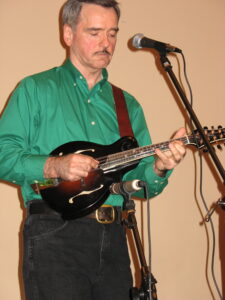
Rigel had grown from a one-man operation in Pete Langdell’s garage/shop to a larger Quonset-like structure in Hyde Park, VT, and added 2 more employees who he knew were experienced and qualified craftsmen and adapted quickly to Pete’s unconventional design and building methods. Business was taking off and before long he moved to a vacant warehouse of approximately 3,000 square feet in the village of Cambridge, VT, which would eventually require the additional five employees.
After getting several requests, he added the G-5 to the top of his line and I was able to see and play the prototype shortly after its completion. Sporting a scroll and a modified lower cutaway, it was a nod to the classic F-style but otherwise was unmistakably a Rigel in every way. However, the CNC technology that enabled him to keep up with the demand for his existing models played only a minor role in the construction process. The hand work involved translated into a higher priced, limited-edition mandolin designed to meet the wants and needs of the discriminating player. After test driving it, I can confirm that it was like being behind the wheel of a finely tuned sports car. Over the years, I’d gone through several G-110s, trading up when Pete would call and tell me that he’d built one that I should compare to the one I was playing. And so it went. He’d send me his and I’d send him mine … and now he unveils his latest masterpiece and says “What do you think, do you need one of these?”
Time for a news break: In 1999, the Chesapeake bubble burst and I returned to the world of acoustic music, giving me more reason to trade for better sounding Rigels as they came along since I was again playing into a microphone. Now, after Pete made the case that he doubted he could create an instrument that would sound superior to this G-5, I guessed what was coming and was halfway right. No, he didn’t offer me the prototype on the spot, but said he’d build me one and be open to discuss any personal touches I’d like to see. Wow! Where do I sign?
After a couple weeks and many sketches, I came up with a design that would include a smooth reverse radiused curve in lieu of the tooth-like point on the rear lower edge whose tip connected directly with the modified lower edge between it and the cutaway. A departure from the symmetry of the pear-shaped body for sure, but it “spoke to me”, so this is how I basically wanted it to look. Then, a darker, smaller sunburst area under a satin varnish finish. No gloss anywhere. Oh, and no pick guard and no block inlays, I much prefer dots. An ebony strap button on the back side center of the scroll and I’d be a happy camper. When I sent this list of wants to Pete, he was completely on board and suggested I make plans to come up to the shop when he had the neck attached to the body which would include the back, all still “in the white”. My job would be to select a top from four that he’d pre-cut from different species of spruce and had displayed different characteristics after being tap-tuned then braced and popped in place (not glued) and tested strung up with a bridge set in place. What, you say? One of the many things that make a Rigel different than anything else that preceded it. Think of a pot or pan with a lip that would allow the lid to rest on that lip flush with but not higher than the side. Yes, it involves a lot of tuning up and de-tuning and I was told in advance to be ready to spend some time trying the different tops, probably multiple times in the process of evaluation/elimination. Fortunately, I wouldn’t be the one switching them out.
After making the trek to Vermont and spending a couple days devoted to this tedious task, I found myself going back to the top that Pete told me was made from a piece of Italian spruce he’d had for years. Because it would only yield one top he decided to see if all the years of wondering would finally pay off. It proved to be the winner, not by head and shoulders but enough to make it stand out from the others. Pete, who had refrained from commenting or saying anything that would influence my decision, told me at that time that he had a feeling I was going to settle on that one. He was spot on.
When it was completed, fully dried, strung up, and tweaked, he called and proceeded to give me his assessment. Not wanting to sound overly proud of what he’d built, he went through the checklist but concluded with him saying that after he hit the first lick, it nearly brought him to tears. I have to confess that when I took delivery, I felt the same way. The JG-5 would remain a one of a kind and my favorite stage mandolin throughout my years as a performer.
2007 – Kentucky KM-855
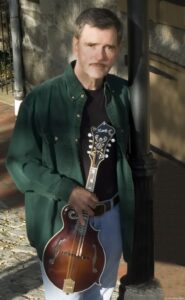
I didn’t acquire any musical instruments during the previous year, but 2006 was indeed memorable. I had been juggling gigs between Robin & Linda Williams and Their Fine Group, John Starling and Carolina Star, and the duo of Jimmy Gaudreau & Moondi Klein for good measure. Then in September, Emmylou Harris enlisted Carolina Star as her backup band, making it the busiest year of my career. Unfortunately, while I was enjoying an incredible ride, things weren’t going well in Jeffersonville, VT. Earlier in the year, Pete Langdell and I had talked and he voiced his concern about imports, knockoffs and fading interest all having an effect on sales and that a recent company meeting revolved around the future of Rigel. Not totally surprised, I was still saddened when I got the news that Rigel would be closing its doors as of August 1, 2006.
Being a car guy since I was a little kid, I couldn’t help thinking about Tucker and DeLorean just to name two of the most daring and inventive but short-lived names in automotive history. I doubt if Rigel will ever find its name in the history of bluegrass but in my book I will continue to state my belief that it was and is the finest acoustic-electric mandolin ever produced. That having been said, the news spread quickly throughout the mandolin community and in the same month, I got a call from David Gartland, marketing director of Saga Musical Instruments, which makes just about every type of stringed instrument you can imagine including Kentucky mandolins.
I had met Richard Keldsen, the president of Saga, in 1979 when the New South toured Japan, where at the time a number of Saga’s instruments were being manufactured. He and J.D. were in the process of finalizing a deal to release a J.D. Crowe signature model Gold Star banjo so his traveling there during our tour was a good opportunity for him to give J.D. a guided tour of their factory and discuss the specifics associated with making it a model that would meet J.D.’s approval and thus carry his signature. He was also a huge fan of bluegrass so seeing us perform was a plus. I’d gotten to speak with him there on several occasions, but I was still playing my old Gibson and the subject of Kentucky mandolins never came up, not that I was looking for that to happen. Even though his focus was on wrapping up the deal with J.D., I’d evidently made a lasting impression as that was one of the first things David brought up in our initial conversation. We went on to talk about many things but because he too is a mandolin player the majority of the conversation revolved around the various mandolins I’ve played over the years. Since it was the closing of Rigel that initiated this call, I gave him the short version of the previous story and told him that I hadn’t given any thought to playing anything other than the JG-5 which he wasn’t aware existed because it wasn’t a production model.
That led to my telling him I would be performing with Emmylou Harris, one of the headliners at Hardly Strictly Bluegrass, the following month and would have it with me. Hardly Strictly is a huge event held in Golden Gate Park, not far from Saga’s headquarters in south San Francisco, and free to the public. Not surprisingly, he and Richard had been in attendance every year since it started in 2001 and because we were getting there a day early to rehearse, David and I agreed to meet at the hotel where the band was staying before I had to show up for rehearsal. When the day came, we hooked up in the lobby, grabbed a couple of chairs and spent the limited time we had getting to know one another and talking about things other than music and mandolins and then making a plan to get together later for dinner. That worked fine for me since he suggested one of his favorite places that had a casual atmosphere and great pub food and he had a car. No problem.
This time around, the conversation eventually drifted to Saga and the prospect of my becoming a part of their “family”. I already knew from having worked with J.D. that although he had a signature model banjo and his name and photo playing that instrument appeared on their list of artists, his deal didn’t require him to play it exclusively on performances, or ever for that matter. One of his vintage Gibsons would always accompany him on stage.
My involvement would be a similar deal although there was no talk of a Jimmy Gaudreau model Kentucky, and I wasn’t expecting one. I would still choose to play my Rigel on stage and because he confided that they were going to re-introduce the KM-1000 early in 2007 I might consider having my photo taken holding the prototype which would work great. He asked if I was planning to attend the annual SPBGMA event held in Nashville the first weekend in February and I told him that because of the traveling involved in my performing schedule, it wasn’t likely, and I was looking forward to being home watching the Super Bowl.
Then, somewhere between Hardly Strictly and SPBGMA, I learned that Emmylou was booked to play the Opry at the Ryman Auditorium on that very weekend and so I called David to tell him the news and we immediately put a plan together. His days at SPBGMA would involve him manning the Saga booth, but he had evenings free. I arranged for him to join us (Emmylou and the band) for dinner at a pre-selected restaurant within walking distance of the Ryman and then be put on our guest list as well, which he didn’t see coming but happily accepted. To complete the plan, I would join him the following day at the convention center where SPBGMA was being held. It was close to the airport, from which I had an afternoon flight back to DC. It was at SPBGMA that he showed me the new KM-1000 and with camera in hand proceeded to take a number of shots, one of which was used on their website until 2024. Now, you can see it on the gallery page.
And yes, the subject of my acquiring one of these models once it became available came up but I threw out what I thought might be a better idea. Because Emmylou closed the show with Get Up John, I had to quickly step off mic and re-tune my Rigel to the F#ADDAAD tuning that Bill Monroe chose to use on his 1953 recording and with limited time and all eyes on me, I struggled to get it close but rarely nailed it. I managed to get away with it but always thought it would be nice to have another mandolin with a strap on stage ready and waiting in that tuning. Since the KM-855 had been their top-of-the-line F-model up until this point, they had a number of them in stock and could provide me with a pair of them shortly after he got back to their warehouse and picked through their inventory looking for the two that checked all the boxes. When he called to tell me that they were on the way, he said he’d spent a good amount of time and the differences were subtle, but he felt confident the ones he was sending were mandolins I would have no problem taking on any stage and producing (projecting) a great sound. He was right! The photo taken by David at Hardly Strictly in 2007 appeared on the home page of this website until the website underwent a major redesign in 2026. It’s on the gallery page now.
2008 – Kentucky KM-805
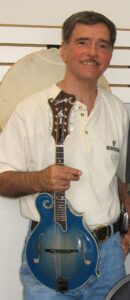
I had talked to David Gartland on several occasions about Pete Langdell’s bracing innovations and ability to improve the sound of both new and older stringed instruments customers were looking to preserve and/or upgrade and eventually came up with an idea. It would involve my talking to Pete to see if he was interested in modifying a Kentucky KM-805 which shared most of the specs with the KM-855 minus the decorative touches. Now that he was back in his home shop and building Rigels on a per-order basis, he had more time to tackle the challenge, so a deal was struck and he soon took delivery of the KM-805 after which he called me and told me that it sounded great right out of the box and he’d have to strip it down to the “bare bones”, remove the back, check its graduations as well as the top and then replace the traditional tone bar braces with the unique pattern he’d been using on the Rigels for years. Finally it would require refinishing and because there was no set deadline, there were countless colors to consider since anything that resembled the original sunburst, to me was not an option.
My calendar was starting to fill up with gigs playing with Robin & Linda Williams, Carolina Star, and duos with Moondi Klein and with Orrin Star when I got a call from Emmylou’s management telling me that she was seeking an opening act for her summer tour and was that something Moondi and I might be interested in doing. I knew going into the year that she was going to go a different direction with an electric country backup band in lieu of the Carolin Star acoustic sound, so I approached Moondi with the idea and he was totally in. It would involve a number of dates during June and July stretching from coast to coast and one in Toronto, Canada. It came with some drawbacks, but it did give us the opportunity to perform at some prime venues for much larger audiences than we would normally see on our local duo circuit.
(Here, I must digress briefly. Moondi and I needed a road manager for the gig and since we had to provide our own transportation, someone to share the driving would also be helpful. Luckily, I had a longtime friend and bluegrass fan in Rhode Island, Jim Moody, who was willing to accept the job! I had known Jim since we were young kids. Coincidently, it was at a jam session at his parents’ house where I had first picked up a mandolin.)
When the tour started, the idea hit me to call Pete and see if he’d consider doing a shaded blue finish on the KM-805 and he saw no problem doing that and would be able to get it to me before the tour ended. As luck would have it, he had a friend living in the state of Washington and at some point prior to July 24th when we were scheduled to play near Seattle I got a call from Pete that his friend had taken delivery of the mandolin which arrived in excellent shape and that he would be attending the show, thus making sure it was in my hands before showtime. I, of course, was excited to see it and to show my thanks, I arranged for him to be on my guest list. Unfortunately, I wasn’t able to score him a backstage pass, so when he showed up I had to leave the backstage area to meet him in the parking lot. No problem spotting him since he was the guy carrying the mandolin case. After exchanging pleasantries, he opened the case and I in turn opened my mouth, a truly jaw-dropping experience. Then, with only minor fine tuning, I hit the first lick. I’m finding it hard to come up with the words that describe my reaction, but it exceeds simply being completely blown away. Again, because Pete didn’t see any point in altering the neck profile while it was unfinished, it felt like the KM-855 I’d be playing so I had already made the decision to play it on our set. But before that as I was wandering around and carrying it in the backstage area, I ran into Emmylou and pointing at the case, asked her if she’d like to see something cool! Getting a positive response, I opened the case and watched her eyes light up as she gazed at this beautiful blue mandolin. I have to confess that I was setting her up for my next move. Because I knew that there were certain tunes that she nearly always performed on her show, all I needed to do was point to the headstock and she couldn’t help but smile, followed by “blue Kentucky girl, I love it!” My thoughts exactly.
The show would move on from there to San Francisco and then to Saratoga, CA, where Richard Keldsen and David Gartland from Saga would have the opportunity to see and hear this incredible mandolin. Their reactions were no less than I expected as, like me, they were both blown away, not only by the appearance but particularly by the sound. But, as I also expected, it would not ever become a production model or even an option as it was simply too specialized.
2008 – Trinity College octave mandolin and bouzouki
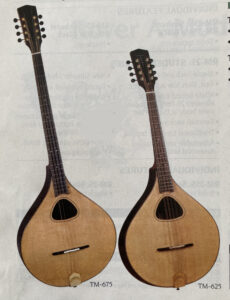
Saga launched the Trinity College line of musical instruments in the late 1970s. It was designed to provide high quality affordable alternatives to the pricey hand-crafted instruments typically used in Celtic music. The line included mandolins, mandolas, octave mandolins and Irish bouzoukis, all of which featured the flat-top flat-back characteristics found in the type of stringed instruments used in the traditional music that has been passed down through many generations. While big name companies steered clear of the limited market, Saga filled that void.
Now, for the story of how I got involved. It starts with the fact that my wife, Gloria, and I are both fans of Celtic music and have attended a number of Irish jam sessions both here and in Ireland where, in Doolin, we were directed to a gathering of players regarded as the best of the best. At this level, the term jam session as we know it doesn’t really apply. It was more like a closed session with fans and hopeful future participants in attendance. We’ve been to a number of sessions involving students of the music which in comparison are the vast majority, both in Ireland and here. But one of the things all these players have in common is discipline when it comes to playing the tune. Improvisation has no place in traditional Celtic music and since it plays a huge part in a number of musical genres including bluegrass, I’m relegated to the ranks of a non-participant. Yes, I’ve recorded tunes like “Fisher’s Hornpipe”, “Whiskey Before Breakfast”, and “Red Haired Boy” all of whose roots trace back to Celtic origins, but it’s just me playing the way I hear it, which has always been the case.
That having been said, you can only imagine my surprise when a large box from Saga showed up on our doorstep totally unexpected since I hadn’t ordered anything and hadn’t gotten any notice that they were sending me something. Then after opening it, my surprise turned into bewilderment. I removed two cases that looked like they contained banjos. Wrong! The shorter case contained an octave mandolin and the longer one contained a bouzouki. That much I knew, and the stamped bottom seam brace viewed through their triangular sound holes identified them as Trinity College instruments. But they were of a different variety than I’d ever see in the catalogs I’d been getting over the previous 3 years. Same size and scale but different shaped headstock and logo for starters. Then, the biggie. The backs and sides were made from what I later learned was solid east Indian rosewood as opposed to the solid maple used in the standard models. Those featured solid spruce tops but flat as you would expect to find on traditional models. Besides the aforementioned triangular sound holes, the other difference was their tops were slightly but noticeably arched and a feature you’d find on a typical modern-day mandolin. Again, solid spruce, but as I would learn, of the Sitka variety. These were the same wood varieties that they used in the Blueridge BR-160 guitar I’d gotten in 2007. My initial reaction was Wow! followed by the question of why was I sent these beautiful and unique instruments. The answer to this and the other questions I had about the wood, top, etc, came via a call from David, who’d been tracking the shipment and knew when they had arrived. As I recall, the reason he chose not to give me a heads-up was to hear me describe my reaction and confusion. It obviously got the desired results as I could hear him trying his best to contain his obvious amusement while I was doing my best to move on to getting some answers regarding the motivation of producing an upscale model and why me?
Well, here’s the scoop. These were prototypes not intended to replace their traditional models. They were “specifically designed to meet the needs of professional musicians and any mandolin player who is looking for instruments more suited for Celtic or fiddle-style music”. Yes, I took that from the 2009 Saga catalog which I kept since that featured a full-page ad on the back cover showing me playing the new octave mandolin with the bouzouki next to me on a stand. Hence, that’s one of the reasons they were sent to me. Like I stated earlier, I’m the guy who has no business trying to participate in a Celtic jam session. But in Saga’s eyes, I’m the guy with enough name recognition as a mandolin player known for thinking outside the box, thus making a prime representative to hopefully attract like-minded players. To demonstrate an example of how I could apply the octave mandolin, I made the decision to use it on “New Morning”, a tune that Moondi’s daughter, Lauren, pitched to him and that we’d been tossing around for a while trying to come up with an arrangement. It must have been fate, as not only was it the missing link for the tune but it checked the box for my using the octave mandolin in a non-Celtic setting. For us and for Saga, it was the icing on the cake. You can see and hear the octave mandolin in the “New Morning” video at the top of the video page. Art Wachter, who is responsible for this totally redesigned website as well as the photo on the Saga catalog (and many others), arranged for the production of that video.
Which brings me to the bouzouki, and I’ll try to be brief. Basically, it’s an octave mandolin with a longer scale and a slightly different tuning, that being the first string is tuned to a D rather than an E. Sure, you could tune it up to an E, but then you have an octave mandolin which because of the longer scale would just make it harder to play. I don’t have particularly large hands or long fingers, so the octave mandolin already pushes me to my limit at least in terms of playing lead. I did however manage to use it as my backup rhythm instrument on my cut of “Dub’s Lin”, a tune that appears on Pieces and Bits. If you choose to check it out and listen closely, you won’t hear the typical sound that you’d find coming from a traditional Irish bouzouki. That’s because the inside third and fourth strings were replaced with the same gauge plain strings used as first and second, making them become an octave pair, similar to what you’d find on a 12-string guitar but for that comes as a set. Not the case for a bouzouki. That requires finding /buying loop end singles. But what an amazing sound. Unique and more appropriate than the guitar backup I envisioned when I composed it. My good friend and recording engineer, Stuart Martin, agreed after listening to the playback with a thumbs up and a big “Oh, yeah!” But alas, that was about the extent of my utilization of the bouzouki. Winging it as a rhythm player using chords I was never shown is one thing. Playing lead in a G-DAD tuning is something I am content to leave to the REAL Celtic musicians … SLAINTE!
2010 – Kentucky KM-1500

Like the KM-1000 prototype I mentioned in the 2007 story, I was one of the first to see and play the KM-1500 in 2009 before it was reintroduced the following year. Actually, they sent me that prototype for critique/evaluation, an assignment I took seriously since it paid homage to the vintage Gibson F-5 I played from 1967 until 1983 and I wanted to get it right. To the best of my recollection, I called David Gartland to tell him that it had arrived safely, but that other than giving him my positive first impression, I wanted to take my time and do an in-depth study before reporting my findings. What I didn’t tell him was that I was planning to show it to John Paganoni, who, as a master luthier, could evaluate structural aspects beyond my visual assessment and how I thought it sounded and played. I also knew that as a close friend, he would give me his true thoughts, whether they be positive or negative, which is exactly what I wanted. As I’d hoped, when I called him to ask what was essentially a favor, he told me to bring it over and that he was curious to check it out. And check it out he did.
Like me, he started with the headstock and the fern inlay in particular as it is what really defines the 1500 series. That got the first “wow” followed by a “really nice feel” as he ran his hand over the neck profile then to the heel and neck joint. Again, high marks. Moving on to a close look at the top, he gave me the look I was expecting to see. Up to that point I hadn’t given him a hint of what I thought about the aesthetics as I was there for a second opinion, from one of the great mandolin builders of our time no less. So, when he paused, and I heard a barely audible “hmmmm”, I knew he spotted what I’d spotted. The bridge placement proved to be correct after a quick intonation check, but the size of the F-holes and their placement appeared to be outside the acceptable proximity to the bridge. Ideally the base of the bridge would coincide with an imaginary line between the inner F-hole points. I can’t remember which direction it was off but it was visibly noticeable, made even more so by the fact that the circular sunburst placement matched it. That caused a slight grimace. Despite these flaws, the sound was impressive and brought another “wow”. To complete his inspection and to satisfy his curiosity, he picked up a small flashlight and a dental-like mirror and proceeded to look at the structural components, things I know little about but Construction 101 for him. Taking his time and checking more closely than I thought he would, he finally turned off the light and removed the mirror and told me he was not only impressed but amazed with the attention to detail involving hand-finishing you wouldn’t expect to see in the more affordable imported brands. BIG nod of approval. Also, because he didn’t see a problem with both the inner and outer carving/graduation of the top and back, he speculated that the F-hole issue was related to the CNC assist used in most commercial production. To me that sounded logical and it also gave me hope that once these issues were pointed out and addressed, it would result in a great looking and sounding instrument, worthy of being marketed as their flagship mandolin.
Moving on. Prior to writing this story, I was able to locate a copy of the review letter I sent to Saga dated August 9, 2009 which, in the interest of accuracy, I referred to multiple times. And yes, in that letter, I did include bringing it to John along with the overall high praise he had for the mandolin. Several days later, I got a call from David thanking me for my efforts and for recruiting John, whose opinions both he and Richard Keldsen, president of Saga held in the highest regard. And no, he didn’t need to get the mandolin back anytime soon to validate our findings, especially since along with the review letter I’d sent along tracings of the mandolin’s F-hole along with the tracings from two different Kentucky models I had for comparison. After zeroing in on what we agreed was the appropriate one, he assured me that all of the issues noted would be addressed before it was officially released sometime during the following year, no target date yet. With that, my work was done. Now it was simply a matter of waiting patiently and not calling him for updates. No second prototypes coming my way, just the eventual call telling me the first shipment had arrived. And no, I wasn’t remotely thinking of replacing my Rigel JG-5 with that or anything else as my preferred stage or studio mandolin, so my reason for wanting one was not that I needed it. More like a feeling of satisfaction when I did pick it up to play it or just look at it knowing I had played a part in its development. Waiting was not a concern, getting it right was.
Fast forward to summer 2010. It took several months but when I got the call, it was from Paul Shelasky, who worked in quality control, telling me that the shipment had arrived, they all looked great, and the setup process was already underway. Anybody who makes, works on, or collects instruments will likely agree that no two instruments of the same exact model will look or sound the same. For that reason, Paul and their setup tech decided to grade the limited batch, a tough task when it was evident from the start that they were all among the best to ever come across the workbench. But in the end, Paul called back and said there was one that was set aside and in the end ranked number one. Since I’d known Paul from his days of playing fiddle with the California-based band Good Ol’ Persons, I had a lot of respect for his musicianship and ear, so I felt very confident that they’d found The One.
Again, I wasn’t in a hurry and because I was going to attend the IBMA World of Bluegrass held on the last weekend of September in Nashville, David, who would be there representing Saga, and I would meet and make the exchange since I still had the prototype. When that time came I can vividly recall seeing and playing it for the first time and feeling somewhat like a proud papa. The look and the sound completely blew me away; definitely worthy of getting top billing as Kentucky’s flagship mandolin!
Over the next several years it would be my mandolin of choice for the local house concerts featuring the Jimmy & Moondi duo. The informal nature of those settings was the perfect opportunity to give it some playing time and me the chance to get a better feel for it. Not that I had any intention of ever using it on a stage performance or in the recording studio. Sorry, Rigel=comfort zone. I did however use it on one occasion in 2011 when I was asked to take part in an event called “A Celebration of American Acoustic Music”, which included various artists demonstrating and talking about the instruments they played. Rather than trying to describe my segment, I invite you to go to the video page where you can see it in its entirely and it will become pretty obvious why I chose to use the Kentucky and not the Rigel. Unfortunately, after viewing it myself, I must admit that I didn’t do the instrument justice as I chose to use my familiar Fender medium plastic pick instead of the heavier types commonly used by bluegrass players. Thin pick, thin tone … oh, well.
But while we’re on the subject of tone, I’m going to end this story by bringing up the name Billy Thibodeau. He is a close friend and very talented mandolin player whom I’ve known since his early childhood in the mid-1960s, growing up in Rhode Island and son of my good friend, Sam Tidwell (see the Gibson F-2 & F-4 stories). We’ve kept in contact over the years and during a phone conversation I learned he’d been playing a mandolin he liked and suited him fine for a number of years but when the subject of my KM-1500 came up, he reminded me that he was at the IBMA in 2010 and talking to me at the Saga booth when I took delivery of it and thus, got to see it at the same time as me and be the second person to test-drive it. Similarly jaw-dropping reactions. It was in that moment that I made the decision to stand by my philosophy that if I’m not playing it then someone else should be and asked if he was interested in the KM-1500. His response was immediate and as I recall more than a simple “yes”. My reaction to that was a sense of satisfaction knowing that it was going to get the use it truly deserved. In 2017, Billy would join Rock Hearts, a New England based bluegrass band which had gone on to become a powerhouse force enjoying national radio and chart activity. You can check them out at rockheartbluegrass.com or by searching YouTube where you’ll find numerous recordings & videos. Then check out the sound of the mandolin. Yes, the very same one I used in my video. Different player, heavier pick equals deeper, richer tone. Their first, self-produced, CD in 2020 led to their signing with Tennessee based 615 Hideaway Records where in 2023 the release of Wanderlust basically ignited the fuse and took them to the next level. The following year their release of Unfinished Bridges served notice that they were headliner bound. All feature Billy playing the KM-1500 which he refers to as his recording mandolin. His attention as a player and use of a Kentucky mandolin led to him being invited to join the family of Saga artists which resulted in his getting a second KM-1500, which he uses as his road mandolin. Good idea. Just enough difference in their tonal characteristics to not put his recorder at risk. Speaking of recordings, as of this writing, the group has just finished a fourth project, a gospel album. The release date has yet to be announced, but I’m already looking forward to it because for me, that’s another opportunity to hear a great band, a cherished friend whom I’ve watched develop into an incredible player, and a mandolin whose outstanding qualities are on full display…a triple treat!
2018 – Rose A-Model
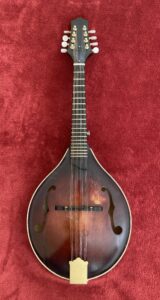
If you have been following these stories thus far, I suspect that like me you are a mandolin player and/or simply enjoy reading about stringed instruments. So, here is yet another case where I didn’t particularly need another mandolin, I just wanted it. This story begins in January, 2004, with the Jimmy & Orrin duo performing at Holy Cross church Fellowship Hall in Herndon, VA, a venue that had become the home to a popular bluegrass concert series. After the show a gentleman approached us carrying a mandolin case and introduced himself as Darby Boofer. He had traveled from Charles Town, WV, where he had a regular day job but was building mandolins in his spare time. He showed us the latest F-model he’d built under the name Rose Mandolins and both Orrin and I got to test-drive it, agreeing that it was very impressive in every aspect. The fact is that because I’d been playing Rigels for nearly a decade and living with the knowledge that the JG-5 was on the drawing board, and Orrin showed interest in the instrument, I excused myself to finish packing up my gear and merchandise. After chatting with Orrin for several minutes, Darby left but not before giving Orrin his card and, as I learned, something to think about. True, Orrin made his name primarily as a guitar player but I can attest that his mandolin skills were equally high level, and as part of our show, we’d included a couple of mandolin duets — a real “hoot” for us and a little added spice we’d found that the audience enjoyed. Sorry to say I cannot remember what kind of mandolin he was playing on the early gigs. With that said, if it was indeed impressive, I’m pretty sure I’d be able to recall it being so. What I can say for sure is that it wasn’t in the league of the mandolin that Darby showed us, hence Orrin’s telling me he was going to give it some serious thought.
Because that was a particularly busy year for me working and recording with several configurations, Orrin and I didn’t have another gig until November. We’d kept in brief touch but again I don’t recall him mentioning that he’d ordered a mandolin from Darby, not that he should have felt it necessary to bring it up. Typically, we would get together a few days before an upcoming gig and it was at that time that I got to see his latest acquisition, a Rose A-model. Apparently, although Darby’s history of building mandolins was by and large F-styles he simply wanted to do whatever it took to please a customer. And in this case, not just any customer, but Orrin Star. It was no surprise when I heard the first chop and then the tonal quality and balance of each string all the way up the neck. This from a mandolin that for lack of a better term, was still in its infancy. And as you might suspect, got even better over time. Better in respect to the Rose, but unfortunately not for Orrin. Sadly, after waging a courageous battle with cancer, in November of 2017 Orrin passed away, a huge loss for me and for the many friends and fans he’d accumulated over his years as an outstanding musician and entertainer.
It was during the late summer of that year when Orrin along with his mother and brother, made the decision for him to move to his mom’s home in New Jersey where he would get the care that he needed. It also provided the opportunity to spend time with his brother who, as his primary executor, would have the responsibility of following Orrin’s directives/wishes involving his estate. Among his top concerns was finding good homes for his collection of various instruments, some of which he’d had for decades, and all for the purpose of playing as opposed to a case dweller or a wall instrument. One of his motivations for moving to the DC area was that it had a large community of bluegrass players and fans and it didn’t take him long to attract a number of students and become an active member of the DC Bluegrass Union. It was there that he met Randy Barrett who in 2017 served as President of that organization and ultimately became the person Orrin’s brother would contact to deal with the instruments and other music related items, of which there were many. After Randy, whom I’d known for years, agreed to assume that responsibility, he called me to make me aware of that fact and read me the list of instruments that would be offered for sale. The Rose mandolin was of course part of that list and I didn’t hesitate to express my interest before he was through reading the list. We arranged to meet at his house the next day and to use a familiar phrase, it was a “no-brainer”. More than another situation where I didn’t need it, I absolutely wanted it – because to me it was and remains very special. It has since occupied the stand in our family room where my old Gibson A-model, before it developed structural issues, sat within easy reach patiently waiting to be played but unlike the Gibson, it’s not apt to play a part in another string of instrumental compositions nor see the inside of the recording studio.
Then again, who knows? Maybe all those things will happen at some point in the future… in the hands of the next keeper. Meanwhile, I’ll continue to play, enjoy, and remember the dear friend and great player who was the previous keeper, and smile thinking that along with a trace of DNA, somewhere on that fingerboard he might have left me some new licks!
Note: Although I haven’t used the Rose in a recording studio, I did a live recording for a series called Mandolin Mondays where players are asked to perform solo, head-on using simple but decent recording devices such as late model iPhones. You can view this at Mandolin Mondays/Jimmy Gaudreau. While at the Mandolin Mondays site, you might want to check out some of the many videos posted over the years. Every style you could imagine from players you may be familiar with to others you probably have never heard of. I’ve done so myself … helps keep me humble.
Also: In 2018, a gift from Orrin’s estate led the DCBU to establish the Orrin Star Scholarship Program for the benefit of young people who are acquiring musical skills for playing and singing in the bluegrass style. Visit dcbu.org for more information.
2024 – Kentucky KM-500
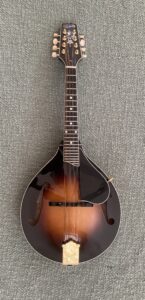
If you have been reading this list from the beginning, first let me thank you for your interest as that justifies the many hours of work it has taken us to compile it and to include the accompanying stories and photos. And so, I find myself in the position of writing what I intend to be the final installment as, again, I am not a collector and have no reason to add to the select few instruments I’ve kept and enjoy playing. Mandolin-wise, that includes the aforementioned Rose and my most recent acquisition, a Kentucky KM-500, also an A-style.
This story begins with my maintaining my relationship with Saga, initially as a performing artist and now after the many years I’ve enjoyed being a part of their family, referring to myself as “artist (retired)”. You won’t see that category on their website, but you will see my updated photo taken with the KM-500. And why might you wonder, when I’ve had a number of their F-models including the KM-1500, did I choose this particular A-model? The answer includes a conversation with David Gartland at Saga along with acquiring the Rose, which brought an appreciation for a model which for the most part never gained popularity among the ranks of bluegrass players. During the first half of my career, I proudly counted myself in those ranks and it would have been hard to find a fan who would say otherwise, that is until 1985 when I joined the Tony Rice Unit. Now we’re talking gray area and fans who would argue that we weren’t really a bluegrass band because we didn’t have a banjo. Ironically, some of these same people praised Manzanita, ignoring the fact that it didn’t include a banjo. Go figure!
When I joined The Unit I was playing the O’Brien, a carryover from my second stint with the Country Gentlemen. Had it not been an exceptional instrument, it wouldn’t have stood a chance hanging in with the Rice, Rice, Schatz wall of rhythm. I used it on all the recordings I did with Tony until 1992 when I got the Paganoni. Right away Tony heard differences he viewed as positive, which prompted a smile and him saying something to the effect of “yeah, that’s what I’m talking about”. That merely reinforced my own similar opinion and that I needn’t look beyond the instrument I held in my hands. But if you have been following my “mando-journey”, you already know that changed in 1995 when I got the first in a string of Rigels. True, I could have simply kept the Paganoni and played it occasionally around the house but I too found myself on a journey music/band-wise, you know, Chesapeake. If you saw or heard the band, you know what I’m talking about. If you haven’t and are curious, you can check us out on YouTube and make your own conclusion. The fact is we didn’t even attempt to try to define it as we quickly figured out that it wasn’t worth the effort. What did become quickly evident was that we were developing a following, gigs were coming in, Sugar Hill Records was offering a 3-CD deal and it was becoming increasingly harder to stay committed to our respective other bands. Call it what you want, we had jumped on a fast moving train that we had no idea where it was taking us or how long the ride would be. And like the other band members, I was enjoying the wild ride when I encountered a bit of a dilemma. After a main stage show at MerleFest in 1995, Barry Poss who signed us with Sugar Hill and happened to be in the audience, approached me with his “observation”. Although I’d been playing the Paganoni acoustically into the microphone while everyone else was plugged in, Barry thought it was time for me to abandon that approach as I wasn’t blending into the big sound we were trying to project in live performance.
This is the actual incident that I failed to mention in the Rigel story which in all probability wouldn’t be part of this list had it not been for a timely encounter in Gettysburg. Timely? Fateful? Accident? All I can tell you for certain is that I wasn’t going to modify the Paganoni, and I didn’t have a clue where to start looking. As it turns out, I didn’t have to look very long as the Gettysburg Bluegrass Festival was the following weekend and although Chesapeake wasn’t booked, I was recruited to conduct a mandolin workshop. I’ll spare you the details of what happened shortly after leaving the workshop area since you’ve already read them or can find them in the story about the Rigel G-110. Ah yes, the uniquely constructed Stratocaster inspired, 8-string marvel literally stopped me in my tracks, and after learning that it was intended to be an acoustic mandolin, I was not deterred. My mind was already racing with visions of me on stage with Chesapeake, plugging in with what I felt was the right instrument for that setting. Like the F-styles I’ve listed, to me they were undoubtedly the right instrument for their respective bands, and here I am looking at what I feel will be the ideal choice to fulfill that role in Chesapeake.
Fast forward. All those thoughts come to fruition and even after the Chesapeake joyride and pulling the plug, the Rigels that followed would accompany me throughout the majority of configurations I was part of during the remainder of my years as a performer. The last one being the JG-5, which I detailed in the previous story. Because I have never had the desire to be a collector, I am happy to report that like the Gibson “Fern”, I was able to find good homes for both the O’Brien and the Paganoni, where they continue to be played and appreciated.
You are probably wondering where this story is going. Well, here goes … Beyond the great F-models I’d performed with from the beginning of my professional career, I’d never given any thought to other mandolins. Sadly, it took the passing of my good friend Orrin Star and being able to become the next keeper of his beloved Rose to trigger a revelation. This particular A-model is simply amazing! The look, the feel, and the SOUND, which is what I remember most about when Orrin played it on stage. The Rose would soon become my go-to mandolin in our family room, replacing the old, modified Gibson oval hole that served me well in that role for decades. I would still pick it up occasionally but in the end, the Rose won out. Again, the Rose is a handcrafted boutique instrument, which after a recent search, I see does not appear on their website. But, if by chance you were interested in one, I would think that, like Orrin, Darby would accommodate you if you are willing to wait and to pay the price. I have no idea about either and you’d have to contact him directly. I can however tell you that his mandolins are well worth the wait, whatever that might be. His prices are posted for the various levels of F-models and to me they look pretty attractive.
But what about the many players who aren’t looking in that market: a guitar player considering a mandolin as a second instrument or the advanced beginner ready to jump to the next level mandolin? Or a player like me, who enjoys playing many different musical genres and doesn’t need a (generally pricier) F-model. This is the gist of the conversation I mentioned having with David Gartland at the beginning of what has turned out to be a long story. That phone call began with my contacting him after going out to the Saga Music website and clicking on the artists page where my photo has appeared since they welcomed me aboard in 2006, shortly after Rigel closed its doors. It showed me playing the KM-1000 prototype which sounded like a good idea at the time since they needed my photo on the artists page and the announcement of its release was forthcoming: a coincidence, not pre-planned. Anyway, I suggested that the photo was outdated and didn’t represent what I was actually playing. Well, that was the Rose, not a Kentucky A-model so I started doing research on the Kentucky A-models, of which there are several, before making the call.
Starting at the top, although I can attest that the KM-900 & KM-950 are as good as advertised the gap between them and the next lower series is significant. And that high quality, affordable, mid-priced level group is where my focus lies. In the Kentucky line, that starts with the KM-140 and goes to the KM-500 series. I’ve read the specs on all of them and even reviewed the KM-272, KM-250, and KM-256 which can be found on YouTube. Although I personally have not played the KM-140 or KM-150, I’ve watched all the demos I could find on YouTube and can say without hesitation that they are impressive in both sound and specs. Since Saga refers to their Rover line as student or beginner’s mandolins in the budget-minded range, I won’t use those terms when talking about these Kentucky mandolins but prefer to call them serious contenders and to me an excellent choice if you fall into the category I mentioned earlier. If that’s where you’re at and you actually go out to Saga’s website and look at the A-styles in the KM-140 to KM-500 range, it’s likely you won’t zero in on one immediately. I say this with a bit of confidence because before I started writing this story I tried as best I could to imagine myself in that position. I’m talking multiple website visits, video demos, reviews, bang-for-the buck considerations, you name it. But hey I’m retired and thus have the time and in this case the desire to be more knowledgeable about one of my favorite subjects. While doing so, it occurred to me that the majority of the mandolins I’ve written about thus far have come into my possession without my having to search or select. That is until I decided it was time to replace my Saga artist photo.
That’s where I needed some guidance and David Gartland was more than happy to help in that regard. Especially when I told him that one of my motivations was the fact that every mandolin player in their artist gallery was pictured playing or holding a Kentucky F-model (including me at the time). No surprise, his first thought was the KM-900 or KM-950 since throughout my career, I was typically seen performing with master-level instruments. True but that was then and this is now. No longer performing and with the Rose, I already have a mandolin in that category, so the next contender is the KM-500. Since he was aware that I had my sights set on being photographed with an A-model, he pointed out the aesthetic features which set it apart, but beyond that he said the feedback he’d been getting from dealers about how it sounded was proof positive that it was a winner. By the way, one of these dealers just happened to be George Gruhn of Gruhn Guitars in Nashville. Okay, I’m sold, ship one out ASAP. A few days later, it arrived, I checked it out, tuned it up, hit a bunch of chops up and down the neck, played a couple fiddle tunes and knew right away it was a keeper. Good thing, because the next thing I did was recruit Gloria to take a photo which is now up on the Saga website and did so feeling good about the fact that it wasn’t just a prop used to get it up on the site quickly. In the past couple of years, I’ve kept it and the Rose within easy reach without maintaining a schedule as to which one I play on a particular day. They each have different characteristics, which I really like and therefore have no preference and no thought process involved. However, since I don’t change strings as I did back in the old days, I’ve been favoring the Kentucky as they were replaced most recently and still have a good bit of life left in them. Alas, because I didn’t tend to both at the same time, the Rose is overdue and sounds as such. I have to admit that I don’t have a good excuse for not doing it sooner, but I also have to admit that I simply hate changing strings!
Acknowledgements
My thanks to John Paganoni, Pete Langdell, Billy Thibodeau, Darby Boofer, Randy Barrett, and Stuart Martin for providing answers when I needed fact checking. And while on that subject, special thanks to Don Moser at Saga for filling in numerous blanks regarding the company’s history, evolution along with dates and facts pertaining to the Kentucky and Trinity College instruments cited in this list. And to Richard Keldsen and David Gartland on this 20th anniversary of welcoming me into the Saga family, I offer my continuing gratitude.
Finally, thanks to Art Wachter for his design concepts, suggestions and many hours of work involved in making this redesigned website become a reality. To my wife, Gloria, who has had to deal with typing and editing to some degree all of my handwritten first drafts. I truly can’t put into words how much I appreciate their many skills, perseverance, and patience.